 music |
 | OSdata.com |
Boolean OR
summary
This subchapter looks at Boolean OR.
free computer programming text book projecttable of contents
|
music |
| OSdata.com |
This subchapter looks at Boolean OR.
free computer programming text book projecttable of contents
|
This subchapter is a stub section. It will be filled in with instructional material later. For now it serves the purpose of a place holder for the order of instruction.
Professors are invited to give feedback on both the proposed contents and the propsed order of this text book. Send commentary to Milo, PO Box 1361, Tustin, California, 92781, USA.
This subchapter looks at Boolean OR.
Please note the differences between a logical Boolean operation, an integer Boolean operation, and a bit-wise Boolean operation.
OR (or inclusive or) requires either object to be true for the result to be true. The OR works like a pair of switches in parallel. Current will flow if either or both switches are closed.
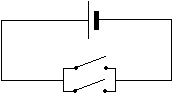
OR is conisdered to be Boolean addition and is represented by the plus symbol: + (such as (A+B). There is no Boolean subtraction operation.
The truth table for OR is as follows:
| A | B | result |
|---|---|---|
| 0 | 0 | 0 |
| 1 | 0 | 1 |
| 0 | 1 | 1 |
| 1 | 1 | 1 |
The OR gate in logic circuits looks like:
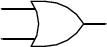
The OR operation has a result of 1 when any of its input variables is 1.
The OR operation has a result of 0 only when both of its input variables are 0.
In OR (Boolean addition) 1 + 1 = 1. Similarly, 1 + 1 + 1 = 1.
PL/I ANY(x) — Pl/I built-in function that performs a Boolean OR on all of the bits of the bit string x. If the data item x is not a bit string, then it is converted to a bit string. If the data item x is CHARACTER then the character string should contain only the characters '1' and '0'. If the data item x is arithmetic, then the item is changed into a positive fixed point binary integer (applying absolute value if needed) and the OR operation is performed on the bits of the integer ignoring the plus sign. The result returned is '1'B if any bit is '1'B and the result returned is '0'B if none of the bits are a '1'B.
Logical instructions typically work on a bit by bit basis, although some processors use the entire contents of the operands as whole flags (zero or not zero input, zero or negative one output). Typical logical operations include logical negation or logical complement (NOT), logical and (AND), logical inclusive or (OR or IOR), and logical exclusive or (XOR or EOR). Logical tests are a comparison of a value to a bit string (or operand treated as a bit string) of all zeros. Some processors have an instruction that sets or clears a bit or byte in registers or memory based on the processor condition codes.
See also Logical Instructions in Assembly Language
Coding example: I am making heavily documented and explained open source code for a method to play music for free — almost any song, no subscription fees, no download costs, no advertisements, all completely legal. This is done by building a front-end to YouTube (which checks the copyright permissions for you).
View music player in action: www.musicinpublic.com/.
Create your own copy from the original source code/ (presented for learning programming).
return to table of contents
free downloadable college text book
Because I no longer have the computer and software to make PDFs, the book is available as an HTML file, which you can convert into a PDF.
 |
 |
| previous page | next page |
| Tweets by @osdata |
free computer programming text book projectBuilding a free downloadable text book on computer programming for university, college, community college, and high school classes in computer programming. If you like the idea of this project, Supporting the entire project: If you have a business or organization that can support the entire cost of this project, please contact Pr Ntr Kmt (my church) free downloadable college text book on computer programming. |
This web site handcrafted on Macintosh  computers using Tom Bender’s Tex-Edit Plus
  and served using FreeBSD
  .
.

†UNIX used as a generic term unless specifically used as a trademark (such as in the phrase “UNIX certified”). UNIX is a registered trademark in the United States and other countries, licensed exclusively through X/Open Company Ltd.
Names and logos of various OSs are trademarks of their respective owners.
Copyright © 2010 Milo
Created: December 6, 2010
Last Updated: December 11, 2010
return to table of contents
free downloadable college text book
|
|
| previous page | next page |
